Tower Defense Strategy: How to Win Waves and Bosses
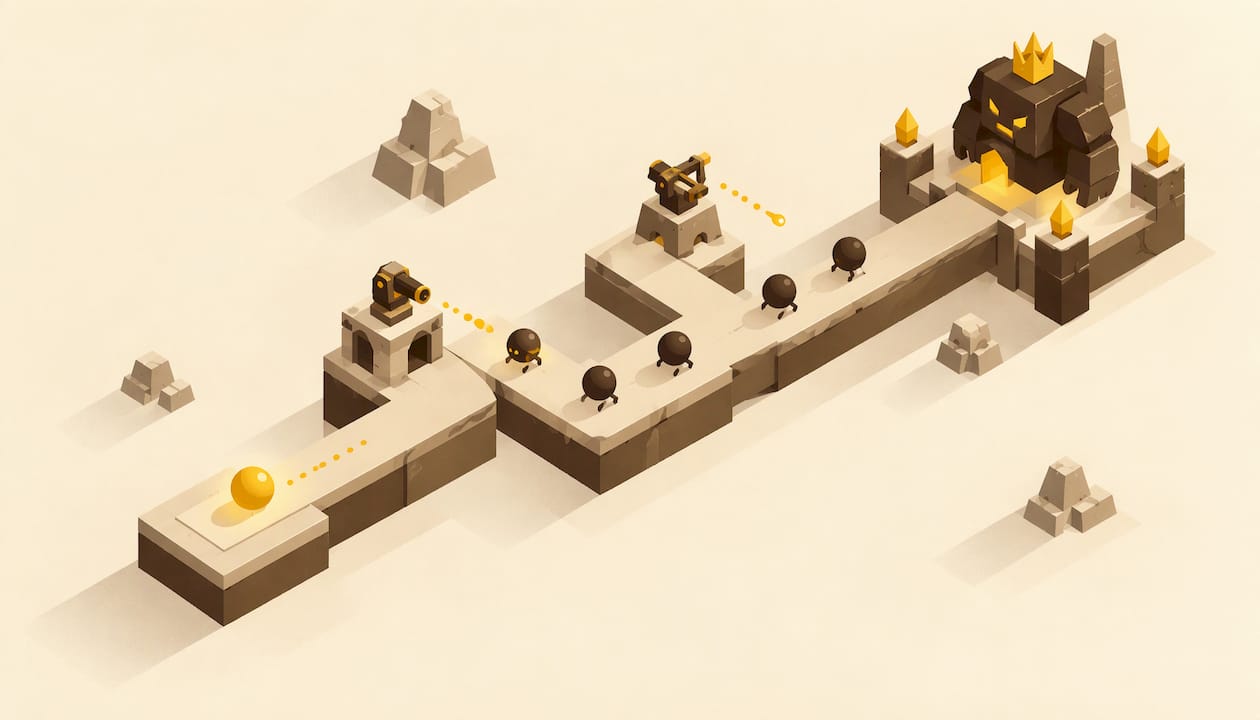
Good tower defense strategy comes down to five habits: put your damage where enemies spend the most time, upgrade before you overbuild, read each wave before it arrives, spend money at the right tempo, and fix leaks instead of ignoring them. You can practice all five in short sessions. In Bounce Bastion, our free browser game, you aim bouncing steel balls to defend a wall, and every chapter forces you to make these same choices in a few minutes.
This guide is for casual players who want to get better without reading a manual, and for genre fans who like a clean explanation of why the usual advice works.
TL;DR
- Damage that sits where enemies linger beats damage spread everywhere. Position matters more than count.
- Upgrade a well-placed tower before adding a weak new one, and add one control tool (a slow, a stun, a blocker) before luxury damage.
- Look at what the next wave contains and match your answer to it: area damage for swarms, burst for tanks, priority targets for healers.
- Spend money according to your income state, and save before known spike waves.
- Practice the loop in short runs: our free game lets you play all 50 chapters and use every combat upgrade without paying.
Table of Contents
- What a tower defense game is really testing
- Placement: make enemies stay in your damage
- Upgrade order: what to buy first
- Read the wave before it spawns
- Money tempo: when to save, when to spend
- Common mistakes that cost runs
- How to practice in short sessions
- Try the ideas in Bounce Bastion
- A short checklist to keep
- FAQ
- Sources
What a tower defense game is really testing
Every tower defense game, whatever the theme, asks the same question: how do you turn a limited, growing budget into enough damage, in the right places, at the right time? Enemies follow a route. You get resources over time. Each wave is slightly harder than the last. You lose when too much gets through.
That means winning is rarely about one clever trick. It is about a chain of small decisions where each one either adds damage, adds time, or adds money. If you keep those three levers in mind, almost any game in the genre becomes readable.
- Damage is what kills enemies.
- Time is how long enemies stay inside your damage. Slows, longer paths and blockers all create it.
- Money is what lets you buy more of both, and it grows if you spend it patiently.
Most beginner losses come from buying damage in a panic when the real problem was time or money.
Placement: make enemies stay in your damage
The single most useful rule is that a tower in a great position is worth more than two in mediocre ones. One long-running Defense Grid guide puts it plainly: it is generally better to upgrade a tower in a good spot than to build more towers in poor locations. The same guide notes that towers cannot shoot through each other in that game, so line of sight matters, and that lengthening the enemy path is usually far more effective than adding more towers.
That last idea applies broadly. More path inside your range means more seconds of fire on every enemy. In games where you can shape the route, a guide on that title recommends long S-shaped paths to maximize firing time, and warns never to seal the route completely, because enemies with no alternative simply walk through your towers.
Translate this into practical checks:
- Find the corners. Turns, loops and bottlenecks keep enemies in range longest. Put your first towers where range circles cover two or three segments of the path at once.
- Cover your best tower. Group towers so that they overlap, so when something gets past one, another is already firing.
- Protect what matters in the center. A compact defense covering the final approach beats a thin line along the whole route.
- Check line of sight and blockers. If something can block your shots, your effective range is smaller than the circle suggests.
When the map does not let you build
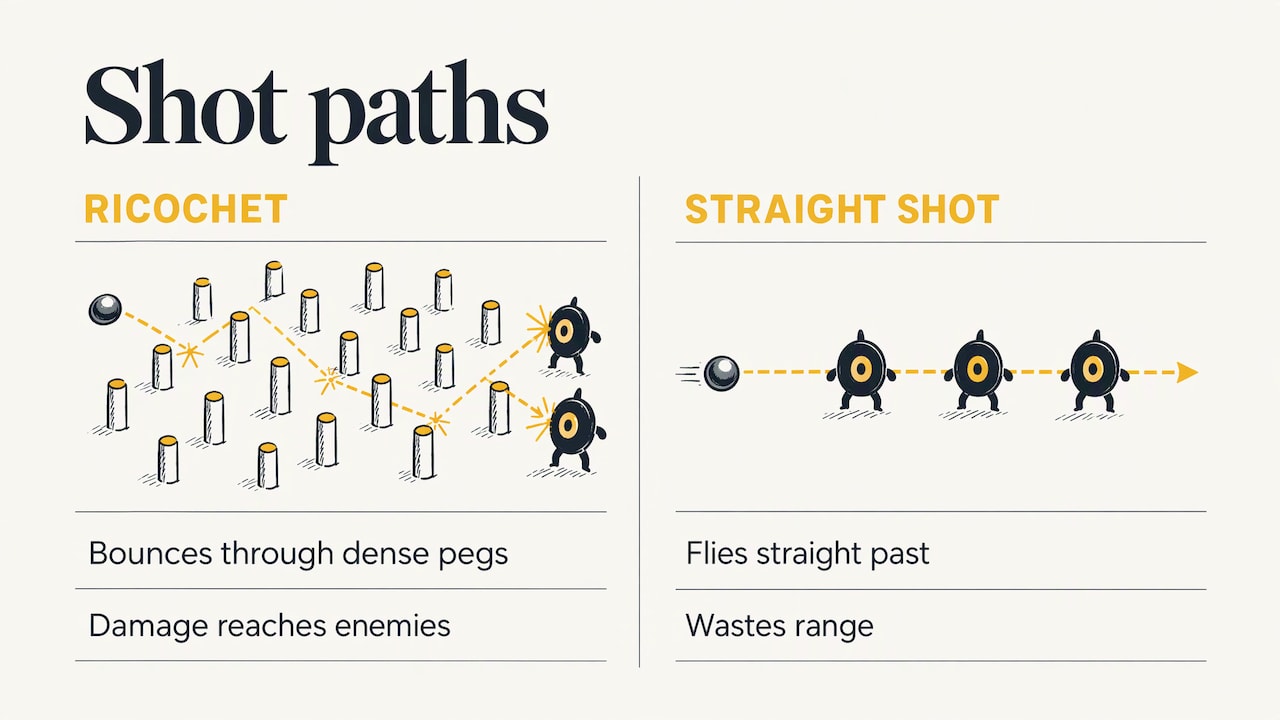
Not every game gives you a grid. In Bounce Bastion there are no tower slots at all: you aim steel balls and they bounce through pachinko-style pegs toward the enemies. The same principle holds in a different form. A shot that ricochets through a dense cluster is the equivalent of a tower at a corner, and a shot that flies straight past is wasted range. You are choosing where damage lands, only with an aim line instead of a build menu. Our beginner tips for the first chapter walk through how to think about that.
Upgrade order: what to buy first
A useful default order, which matches what most strategy guides converge on:
- Cheap, reliable damage. You need something that reliably kills the first waves.
- One control tool. A slow or similar effect multiplies the value of everything else, because it adds time.
- Upgrades on what already works. An ExitLag guide to the genre advises upgrading only when the upgrade beats a new tower in value, which is the same logic as the placement rule above.
- Targeting before big numbers. Making sure your damage hits the right enemy often matters more than raising the damage figure.
- Scaling late. The same guide suggests spending the last third of your budget on scaling rather than panic buying.
A simple test before every purchase: “What problem does this solve?” If you cannot name it (leaks from fast enemies, a tank that survives too long, a swarm), you are probably buying out of habit.
The economy-first rule
In games with income buildings, there is a recurring pattern. Money compounds, damage does not, so early income can pay for itself. One community economy guide for a Roblox tower defense game gives figures for how quickly its income towers pay back, and also warns against two opposite mistakes: pouring everything into early damage that becomes obsolete, and overinvesting in income so you die before it pays off. Those numbers belong to that one game, so do not copy them elsewhere. The shape of the lesson is universal: balance the two, and match your investment to how long the match will last.
Read the wave before it spawns
The biggest jump from casual to confident play is looking at what is coming instead of reacting to what is already leaking. Different enemy types need different answers. A wave guide for one popular game summarizes the standard counters by enemy archetype, and they carry over to most of the genre:
| Enemy type | What it punishes | Reliable answer |
|---|---|---|
| Swarms of weak units | Single-target towers | Area damage |
| Armored tanks | Weak, rapid hits | High burst or armor-ignoring damage |
| Fast runners | Slow-firing towers | Slows, fast-firing damage |
| Healers | Everything else, by keeping the group alive | Kill them first |
| Hidden or flying units | Towers that cannot see or hit them | Detection or anti-air |
The same guide recommends keeping a neutral, all-purpose damage option as a Plan B for waves that combine types, such as a tank escorted by a healer. Mixed waves are where most runs end, so being able to switch from “swarm answer” to “tank answer” quickly is worth more than a perfect opening.
Bosses are a different test
Bosses combine high health with a mechanic: they are fast, they shield others, they spawn minions. Your first boss attempt is information. Note what it did, and what you wished you had. Then adjust your upgrades before the next try. Our post on bosses and upgrades for faster waves covers how that plays out in Bounce Bastion.
Money tempo: when to save, when to spend
There is a timing skill that is easy to miss. In some games, unspent resources earn interest. The Defense Grid guide mentioned earlier explains the consequence: when enemies are not threatening you, saving can be worth more than building, and when you are earning no interest anyway, you should spend aggressively. The lesson is to match your spending tempo to your actual income state, not to a fixed habit.
Most games do not pay interest, but the tempo logic still applies:
- Save before spike waves. If you know flyers or armored units arrive soon, keep enough to buy the specific answer.
- Do not hoard during a leak. Money in the bank does not stop enemies. If you are losing health, spend.
- Spend the last of it on the final push. Near the end of a run, keep nothing back that cannot help you finish.
Common mistakes that cost runs
- Building too many weak towers. Count is not strength. Consolidate into upgrades.
- Sunk-cost thinking. A community strategy guide points out that players keep underperforming towers because they already paid for them, when selling and reinvesting would help more. If a unit no longer pulls its weight, replace it.
- Ignoring leaks. One or two leaks per wave are a signal. A second damage lane or a slow is often the fix, and the ExitLag routine says to build a second damage lane only when leaks become frequent.
- Chasing big numbers. A huge damage stat that cannot hit the thing it needs to hit is not an upgrade.
- Never using the early waves to learn. The first waves are cheap to lose. Use them to test placements.
How to practice in short sessions
Tower defense rewards repetition, and it is easy to practice if sessions are short. A good loop for a ten-minute break:
- Pick one idea to test: a new placement, a different upgrade order, a saving point.
- Play a chapter or a stretch of waves with that idea.
- When you lose, name the cause in one sentence: too little time, too little damage, wrong damage type, or too little money.
- Change one thing and go again.
Changing one variable at a time is how you learn what actually moved the result. Changing five means you never find out.
Try the ideas in Bounce Bastion
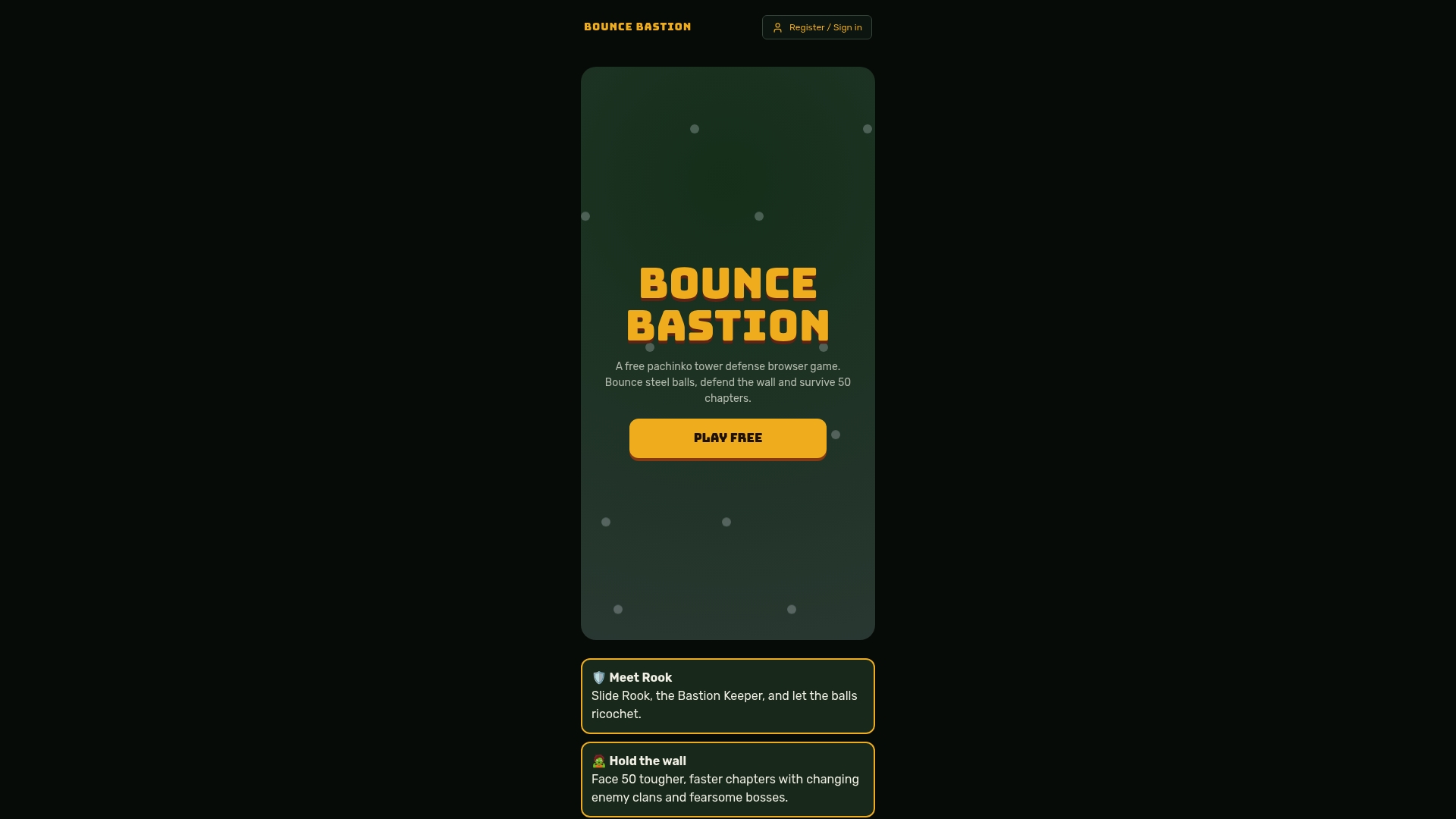
Bounce Bastion is built for exactly this kind of practice. You play Rook, the Bastion Keeper, defending the wall against hordes and bosses across 50 chapters. Steel balls bounce through the field and you control the aim, so placement becomes a matter of where you send damage. Between waves you pick combat upgrades, which is where upgrade order, control and tempo all get tested. Enemies get faster and tougher each level, and no two sessions play out the same way.
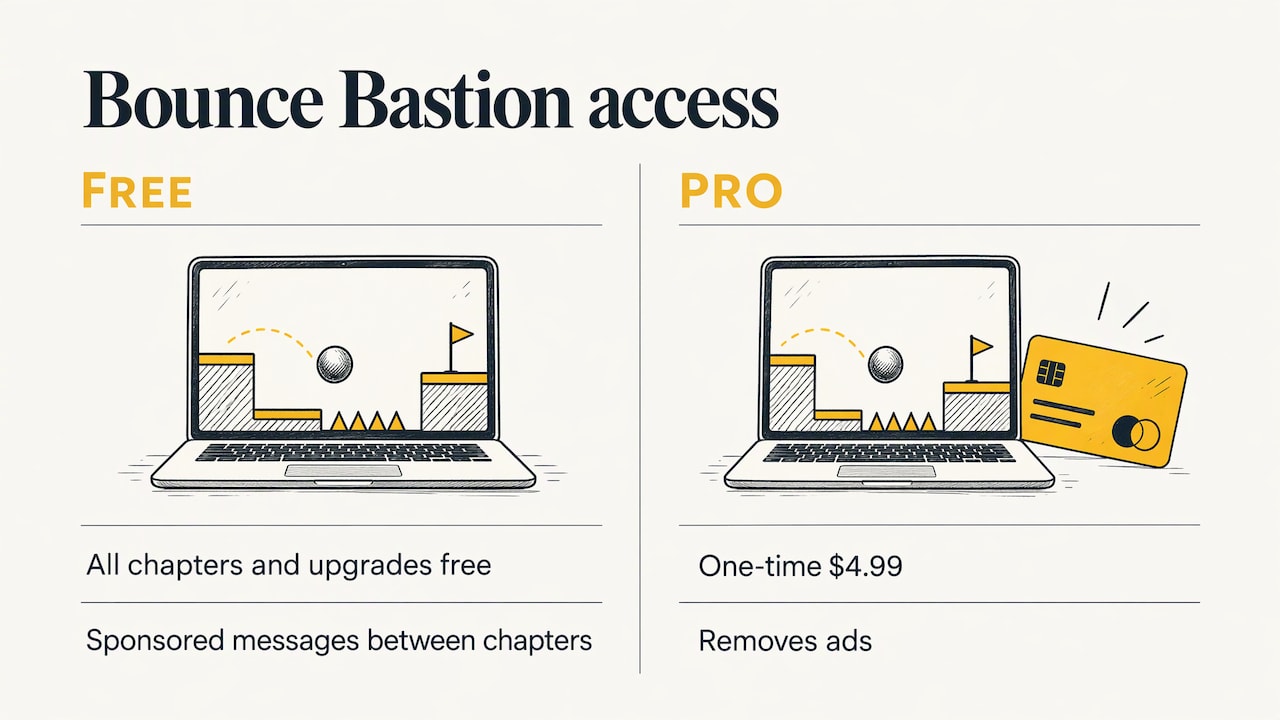
It runs in your browser and all chapters and combat upgrades are free to use. Ads appear as sponsored messages between chapters, and Bounce Bastion PRO removes them for a one-time $4.99. You can start playing right away, see what PRO includes, or read our introduction to the free pachinko tower defense game first.
If you want more guides, our blog collects pachinko defense tips chapter by chapter.
A short checklist to keep
Before each wave, run through this:
- What is in the next wave, and what answers it?
- Where do enemies spend the most time, and is my damage there?
- Is there a cheaper upgrade that beats a new unit?
- Do I have a slow or control effect yet?
- Should I save for the next spike, or spend now?
Five questions, about ten seconds, and they cover most of what separates a lucky win from a repeatable one.
FAQ
How do you win tower defense games?
Place damage where enemies linger, upgrade strong positions before adding more units, and check each wave’s composition so your answer matches it. Add a slow or control effect early, and spend your money in step with your income. Review each loss and change one thing at a time.
What should you upgrade first in a tower defense game?
Start with cheap, reliable damage, then add one control tool such as a slow. After that, upgrade what is already working when the upgrade is worth more than a new unit. Save the last part of your budget for scaling rather than panic buys.
Is it better to build more towers or upgrade existing ones?
Usually upgrade, if the tower is in a good position. A strong upgrade on a well-placed unit often beats extra units in weak spots. Build a new one when you need coverage on a new part of the path or a different damage type.
How can I get better at tower defense in quick sessions?
Test one idea per run: a placement, an upgrade order or a saving point. When you lose, name the cause (time, damage, damage type or money) and change just that. Short chapters in Bounce Bastion suit this well, since each one is a quick experiment.
Sources
- Defense Grid: The Awakening FAQ by John P. Wachsmuth
- Defense Grid: The Awakening FAQ by Brixx79
- Tower defense games: Complete Guide to TD Strategy and Setup
- Tower Defense Simulator Enemy and Wave Guide
- TDS Complete Tower Economy and Money Farming Guide
- TDS Strategy Guide: The 5 Decisions That Win or Lose Every Match